Sunday, September 20, 2015

A Shark Story for My Son

Note: In 1937, a bull shark swam up the Mississippi River from the Gulf of Mexico to Alton, Illinois, where it was caught by a couple of fishermen. That's 700 miles as the crow flies, countless more in the twists of the river. Eau Claire, Wisconsin is only another 500 miles north of Alton. Who knows, stranger things...


They all said even though it was possible, it would never happen. They kept saying it as they stood on the bridge over the river, the lights of the TV cameras the brightest part of the cloudy fall day, with proof swimming thirty feet beneath them in the gray water.

“Bull sharks are part of the elasmobranchii subclass that can survive in both salt and fresh water, but it’s extremely unlikely they would swim this far north,” the biologist said as he clutched the lapels of his lab coat. “I just don’t see how that would be possible.”

The reporter lowered her microphone and failed to hide her confusion. The shark’s fin darted out from under the bridge after a group of ducks that flapped away just before they became lunch. “But there’s one right there,” said the reporter. “How do you explain that?”

The scientist stared at the outline of the shark before it faded into deeper water. “Bull sharks would never swim all the way to Wisconsin. It wouldn’t happen.”

Despite the disbelief of the scientists, there it was, swimming between the old railroad footbridge and the point of the river confluence. The government was convinced it was a hoax or an accident. Someone must have been transporting the shark who-knows-where for god-knows-what, and the truck crashed or, hidden in darkness, some joker backed up to a boat landing and released the beast. There was no way it swam all the way up the Mississippi, took a right at the Chippewa River, jumped over dams, dodged bridges, and navigated the shallow stretches without anyone noticing. No matter how the shark got there, the people who worried about that sort of thing were very worried. The sheriff’s small fishing boats couldn’t capture a beast like that. Killing the thing would cause an uproar. The best hope was that falling temperatures would push the animal south a little each day until it found the Gulf of Mexico again. And if it stayed in Wisconsin, the freezing river would eventually kill it. The best the people in charge could do was wait.

Everyone else who wasn’t an expert thought the tropical visitor was delightful. They arrived at the park that lined the river, parked their cars, and walked over the bridge or down to the point carrying plastic bags full of old meat from their backs of their freezers. They threw their dried out roasts and gamey venison steaks into the water. They tried skipping their leftover chicken thighs and gristly porkchops across the surface. The shark learned quick that he preferred his meat thawed, so he ignored the still-frozen offerings, which bobbed in the river until they warmed, like a giant stew. Sometimes the shark would snatch the meat from the surface without much fuss, and sometimes he put on a show, with a full breach, mouth wide, and terrifying teeth snapping down on the snack. Everyone cheered when he did that. Someone set out a table on the sidewalk to sell t-shirts. One little boy with curly hair and too big teeth ran between groups of spectators to share his knowledge of sharks. “Did you know bull sharks are the largest of the requiem sharks?” “Did you know bull sharks give birth to four to ten pups at a time?” “Did you know bull sharks are the most dangerous shark to humans?”

There were a few close calls. The crowd almost lost a few dogs that were jealous of the shark’s meaty bounty. The canines wandered too far into the water and found only the shark’s jagged teeth racing towards them. Dozens of cell phones and sets of keys plunked into the water under bridge, dropped by shark enthusiasts trying to juggle bags of meat and cameras and purses and toddlers climbing the railing to get a better look. Although it was too cold, several groups of teenagers tubed down the river past the shark, to get a better look, to prove their toughness, and those inflated flotillas provoked at least one attack. They lost a tube. The tuber was fine.

And then, a few weeks later, the show was over. The shark remained, hungry, out of place, and alone, but the novelty had worn off. The people went back to feeding the ducks, which had learned to stay on land to avoid the river’s violent and increasingly unwelcomed guest. The weather got colder, and the sheriff started making plans for what to do with the shark’s body when it finally froze to death. No one cared anymore.

Except for the little boy with the curly hair and the teeth.

He still came to the river and offered the pieces of meat he had hidden in his pockets from previous dinners.  The shark jumped out of the water to eat them, and the boy laughed each time, but they were both worried. So the boy did what he had to do.

He took off his shoes and stepped into the water. His feet went numb immediately, but he gritted his teeth and kept going. He couldn’t pull his pants up any higher than his knees, so they got wet, but he didn’t stop. Then he saw the dorsal fin racing towards him, and he winced and turned and prepared for the worst.

But the shark stopped and swam in a circle in front of him, and the boy relaxed. He pulled a slice of ham out of his pocket.

“Hey,” he said, “you need to swim south.” He threw the ham downriver. The shark swam to it, ate it, and returned.

“No,” said the boy, “you need to keep going. Otherwise you won’t survive.” He pulled out a piece of hamburger and threw it farther. The shark chased it, ate it, and came back.

“You don’t understand,” the boy said, and sighed.

If sharks stop swimming, they drown, but this one paused for a minute and turned its great head and looked the boy in the eye. The boy looked back, face full of worry and hope. He whispered, “Please.” And then the shark understood.


Gordon, a few years ago, at the aquarium
The boy had one morsel left in his pocket, half a hot dog. He pulled his arm back, exhaled, and threw it as far down the river as he could. The shark raced to the ripples it left in the water, chomped the morsel, and kept swimming. The ducks looked around and hopped back into the river. The boy stood on the point that marked the farthest north a shark had ever swam. He stood there for a long time.

Sunday, August 30, 2015

Things I Left in My Classroom Over the Summer

1. Photomosaic Darth Vader. Which isn't literary at all, in an English classroom, no less, unless you approach Star Wars through a monomyth archetypal lens, or examine composition and film techniques to uncover the film's appeal, or take a historical approach and research the 1970's political and economic situation and analyze instances of those influences in the movie, or uncover characterization, or plot, or explore how Mr. Vader has affected the presentation of villains in the sci-fi genre, or in film, or wherever. Apart from all that, it's just a cool poster.


2. This juice box. I am looking forward to drinking it, but I'll probably give it to a study hall kid with low blood sugar, or one who's thirsty.


3. A Shadowy Figure in the Corner. One fourth hour a girl, a girl with troubles I can't begin to understand, looked up at me with real fear in her eyes and asked what the man in the corner was doing. I laughed and shook my head, and she pointed quick, because she didn't want the apparition to see her, and she started shaking, and I wonder how many people would know how to deal with a hallucination, a terrifying demon in the corner, in such a way that protects her and maintains her dignity in a room full of fourteen-year-olds, and that helps her improve her writing skills and score well on the standardized test, and that gives her some sort of hope that she'll be able to find food tonight, and for the rest of her life. That fourth hour I tried my best. I don't know if I succeeded, but I tried my best.

4. $40,000. Because I get paid what I got paid in 2007, and I get it, I get it, tough times, we all had to tighten our belts, but my belt is still tight, and I just need to know when I get to loosen it. You showed me a grid full of numbers when you hired me, full of what I was supposed to be paid, and if that deal changed, if you're never going to hold up your end of that deal, you need to let me know, because I work hard and I get better every year. You need to let me know because then I can try to understand how schools work best with lowest bid teachers, because these aren't roads that can be repaved, these are kids, these are lives, these are investments and I'm how you get a payout and if you think freeways and business subsidies are a better bet, that's fine. That's not fine, but that's fine, and I just need to know.


5. A Dust Globe. It's the most incredible project student project I've received. We read Of Mice and Men and everyone made a museum artifact from the '20's and a girl made this, with her hands, with her mind, and it's impressive and creative and it never would have existed if I didn't type up the assignment sheet and set the due date. I can't take, would never take any sort of credit, but I played a role in the creation of this cool thing, of a thousand cool things. Tens of thousands of cool things.


6. A birthday card from my kids, a rock from my trip to Korea to visit my brother, and a small glass from my high school English teacher's funeral. These things mean something to me.


7. Fifteen tables, thirty chairs, a white board, and a podium. That's what I will need to take 150 teenagers and make them better at important things like reading and writing and speaking, and thinking, and avoiding the pitfalls of advertising and working with others, and using technology and researching. There's other stuff too. We start tomorrow.

Sunday, August 23, 2015

A Summer Story, For My Daughter

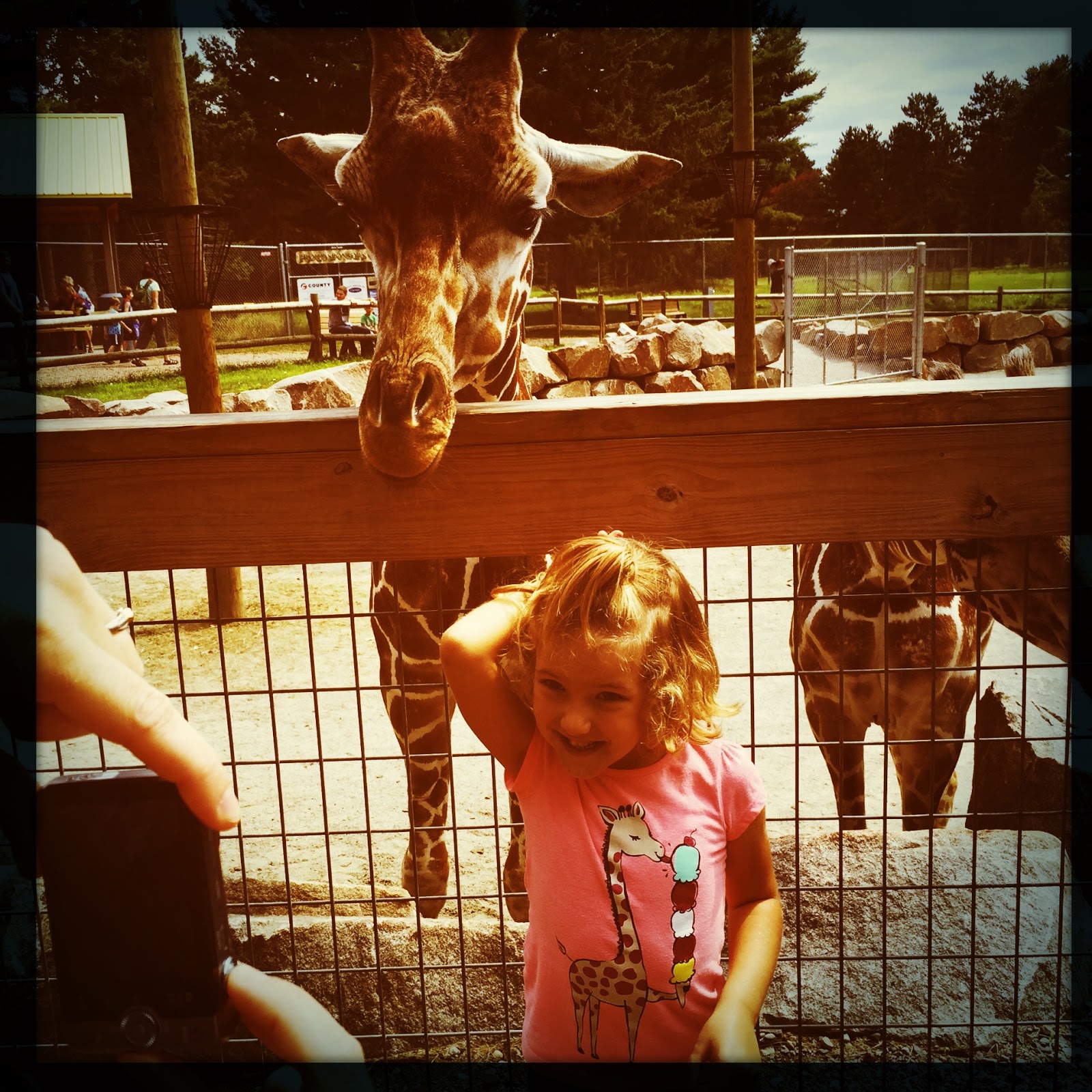
Note: It occurred to me that for someone trying to publish fiction, this blog is notably light on fiction. And my kids keep pestering to put something on here for them, with their pictures. So, two leaves, one giant giraffe tongue.

My actual daughter, feeding an actual giraffe
The story starts as most stories involving giraffes do. A little girl and her family visited the zoo, stood on the wood platform, and fed the animal carrots out of a paper cup; after posing for a few pictures, the girl looked up at the creature with just the right angle of smile that bonded them instantly; the animal circled its enclosure a few times to build up speed, jumped the fence to follow the family to their car, then followed the car down the side of the highway to their home. It ran the whole way to keep up. When the car crossed a bridge, and the giraffe stayed on the ground to run across the train tracks or road or stream, it felt to the family like they rose to the giraffe’s head level. When the opposite occurred, the giraffe racing up a hill that bordered the highway and the car staying on level ground, the impossibly tall animal grew impossibly taller, and the family looked up at it like they were seeing a skyscraper for the first time.


When they returned, they faced all the problems families normally do when giraffes follow them home. The giraffe cleaned the leaves off of all the trees in a few days, then had nothing to eat. The giraffe wanted to follow the girl to the park, but animals weren’t allowed. The family cat’s tail puffed up to twice its size and never went back down. The giraffe wanted to contribute, but it couldn’t work the lawnmower, or the dishwasher. One day, it nudged the windows to all the upstairs bedrooms open, found a brush and roller, and repainted all the walls. The family appreciated the thought, but the yellow it chose was the dad’s fifth favorite color, the mom’s fourth, and the brother’s third to last. The girl liked yellow second best, but she would have preferred pink. The family said thank you to the giraffe many times, but it knew they didn’t mean it.


Recreation of a giraffe lunch
The family did what all families do with their out-of-place giraffes. They called their friends to see if anyone needed any Frisbees retrieved off their roofs. They called the men and women who worked for the city to see if they needed any help hanging Christmas lights, and they did, but not for another four months. Then the family came up with a plan that worked great for a few weeks. The giraffe walked around the neighborhood, and neighbors gave it their cameras, and it would take pictures of what their houses looked like from above. Some of the neighbors found the pictures delightful. Others wished they were from even higher up, but there was no way the giraffe would fit in a helicopter. It only took about three weeks for the giraffe to get to everyone in the whole southern half of the city who wanted a picture. Then it was back to laying in the girl’s yard, sighing a lot, and looking up whenever passing dogs started barking.


In most giraffe stories, this would be where the girl says goodbye to the giraffe, maybe with a tear or two, and it walks back to the zoo. Maybe a few years later, the family comes back to the zoo, and the girl is older and she doesn’t care about giraffes anymore, but when she sees the giraffe that repainted her room she remembers what it was like to be a little kid for a moment, and she gives the giraffe a big hug, much bigger than when she said goodbye all those years ago. That’s a sweet ending.


But this giraffe story ends a little different. On the night before the girl’s first day of kindergarten, she walked out to the back yard, after she put on her pajamas, but before she brushed her teeth. The giraffe laid in the yard, and she patted its neck, and it lifted its head to face her, trying hard to look happy, but the girl could still tell how it actually felt.


“You’re not very happy, are you?” asked the girl.


The giraffe shook its head, as if to say, “No I’m not.”


“I know you’re bored, and I know you feel out of place.” The girl scratched the giraffe’s neck. “But I think the real reason you’re unhappy is because all anyone focuses on is how tall you are.”


The giraffe squinted and looked up at the fading sunlight, as if it was unsure if that was the real reason, or as if it had never thought about it.


Giraffe and five-year-old, to scale
“All the jobs we gave you were because you’re tall. The reason the cat’s tail puffed up is because you’re tall. Everyone who walks by with their dogs talks about how tall you are.”


The little girl paused. “There are a lot of other good things about you.”


The giraffe shrugged.


“You can paint really well. You take really nice pictures.”


The giraffe tilted its head, as if to say, “Thanks, that’s nice of you, but that doesn’t change anything.”


“You’re a great friend. You followed us the whole way home from the zoo. And you’re so caring. You really wanted to help the family out, and I think you did a good job.”


The giraffe licked the girl’s cheek with its impossibly long tongue, and she giggled.


“Stop it,” she said. “You should know that people will like you for whatever you want them to. If you want them to like you for your painting, you just have to paint some amazing pictures. If you want them to like you for your photographs, all you have to do is take incredible photos.”


The giraffe tilted its head, the other way this time.


“If you want them to like you because you’re such a good friend, you don’t have to do anything. Because you’re already a great friend, and that’s why I like you.”


Giraffes have a terrible time hugging little girls, but it did the best it could, and the girl hugged back as hard as she could.


The giraffe had to go back to the zoo, because that’s how all these stories end. Giraffes can’t live in the city. It would never work out. But back in its pen, in between paper cups full of carrots from little girls, it painted some astounding pictures. They were so good, everyone forgot how tall the giraffe was.

Sunday, August 16, 2015

A Letter to Myself as a Smoker, One Year Ago Today

Hey man,

You don't know this, but tonight you're going to go outside for a cigarette, and that will be your last one ever, or if not ever, at least for a year. Tomorrow morning you’re going to wake up and decide to skip your morning smoke, because you’ve been telling your wife for weeks that you mean to cut back, and then, when you’re sitting at your kids’ swimming lessons, you’ll decide to be done smoking for good. Believe it or not. Some crazy and irreproducible brain chemistry formula, some unexplainable pinball of synapse firing will finally accomplish what you’ve attempted for seventeen years.

My old smoking porch, now just a porch

So, dude, enjoy that cigarette. Have two. Finish the pack. Because smoking is three minutes of pleasure, 40 cents a cigarette, 4 cents a puff, lit up as many times a day as you can afford or as the guilt will allow. It’s stinky, dirty, toxic pleasure, no doubt. Some people get a little spurt of dopamine from running down squirrels in their cars, some people get a kick out of beating up nerds or grandmas or nuns or whatever. It’s all perverse pleasure, but it’s pleasure nonetheless, and there have been plenty of times, many many times, where I watched people smoke this past year and thought of you, you lucky fucker, with one more cigarette in your future, and thought about how you better appreciate the ever-loving, honest-to-goodness shit out of it. It’s all we’ve got.

One year from now, you’re going to sit in a café, a few pounds heavier than you are now, and watch two ladies smoke at one of the tables on the sidewalk, and you’ll suddenly understand what they mean when they say addiction is mental illness. Up until that moment, you won’t care. What the hell difference does it make what addiction is? Addiction is an affliction of the weak or unintelligent, unfortunate and sad, but ultimately a decision, an act of free will that carries rewards and consequences to be weighed and factored.

I used to set my pack on that shelf next to this taxidermied squirrel, then I'd come outside and say "Hey squirrel buddy, mind if I bum a smoke?" It was awesome.
You’ll start to figure this out tomorrow morning, and understand it more and more over the next 365 days, but that’s not how it works at all. It’s mental illness because you are not yourself. You believe things that are not true, that feel real because of broken circuitry. Yes, you chose to smoke every cigarette you ever had. You chose to smoke in front of your three-year-old, even after he asked you what that white stick was, and if he could try it. You chose to step outside during naptimes, playtimes, during your wife’s labor because you purposely “forgot” something in car that needed retrieving. You chose to excuse yourself from the hospital waiting room while your dad was in surgery to have part of his lung removed, the cancerous part, because he chose to smoke an uncountable number of cigarettes. You chose to have that first one in the mall parking lot behind the store where you worked in high school, just like a little kid chooses to jump from the tree that he climbed, it doesn’t look so bad, you can handle it, it’s no big deal. You alone made all those decisions, but the tool you used was broken. The first time you smoked, it was broken because eighteen-year-olds are stupid. Every time after that, your brain was damaged by nicotine, which made you feel deeply and forever that smoking was good and important, and life without it was simply unimaginable. Picture life without your legs, or your ears, or your junk. Do you want to live that life? Would you choose that? Of course not, so please, please, slide out another Marlboro and step outside and suck it in. The shaking won’t stop until you do.

A Wisconsin smoker's view, most of the year. Why did I quit again?
Sorry man, you’re all nervous now. My intention is not to make this any worse than it will be. Quitting smoking is about as hard as winning an Oscar, and deserves it’s own little thank you speech, so here is what you’ll be grateful for this year. Your wife, because quitting weighs about a thousand pounds, and the most you can carry is five hundred. She’ll shoulder the rest, which is downright saintly, because she can’t understand how your sick and broken brain works and what it tells you about smoking. She’ll just keep offering backrubs and sympathy and rewards. Your parents, and your dad especially, because he fought hard and lost some big battles with cigarettes, but he hasn’t smoked in over a decade. Your own kids will give you some powerful reasons to quit. A handful of students will provide some unexpected reassurance, your coworkers will too. Some British guy named Allen Carr and his materials will make a huge difference, as will everyone on the r/stopsmoking Subreddit. And green tea, because making it is a little ceremony much like stepping into the garage, and it’s got antioxidants and caffeine and just enough placebo power to make it seem like it’s helping.

So, wow. Tomorrow man. It’s going to be a big day. Lots of people, smokers and non, won’t recognize how monumental, how incomprehensibly huge tomorrow will be. They don’t matter. I matter, and trust me, you got this.

Now smoke up, and I’ll see you on the other side.


Eric

Sunday, August 2, 2015

The Life of a Mechanical Idiot

Evidence #1: I don’t remember if I was 6 or 18. The older I was, the more pathetic this story is, so let’s say 8. It was probably 14. My father, his father, and I stood in front of the garage across the road from the family’s cabin up north. Something needed building, and it was a three-person job. I fetched tools, and when I didn’t know which one it was that had been requested (for a big chunk of years the whole pliers/wrench division was pretty hazy for me), I brought an assortment. Then, the thing being built required two pieces of wood nailed together, and my dad looked at me and said, “Why don’t you take care of that.”

Well, holy hell.

That's not a bad looking basement. Wonder who did that?
This was not just the bonding of two pieces of wood with a sharp piece of metal. This was a pivotal opportunity to prove my manhood to my dad, and to prove to my grandpa how good of a job his son had done in raising a strong, skilled boy who was more than capable of hitting a nail firmly in a downward motion so as to drive it into the wood. I found a hammer and squared my shoulders. Dad crouched down next to me, and grandpa leaned forward with his hands on his knees. I breathed deep and visualized my stroke. I kept my eye on the nail.

I missed with the first hit, and hit my thumb with the second. I finally made contact with the third and bent the nail sideways, and kept hammering until dad wrestled the hammer away from me. He asked for a needle nose pliers. I brought him a vice grip.

That accent wall looks like it took a lot of skill.
Evidence #2: My wife and I bought a house, and I wanted to make my mark, a tiny mark, barely noticeable, but something I could point out to all the friends and relatives who would eventually stop by for tours. I tried installing a shelf. “Oh yeah, you see that shelf? That was me. I put that up.” It was a glass corner shelf in the bathroom. Screw the two metal pieces into the wall (which had to be level, for all of you who have never installed a shelf), then slide the glass piece into the slots. Can’t get much easier than that.

Except one of the screws would not go into the wall. I tried my drill, and then a screwdriver, then swearing, then throwing things, then squinty-eyed rage. Behind the wall was either the chimney or some ductwork or an undiscovered vein of pure titanium. I got so mad I had to take a walk.

I would like to sit in that well-crafted basement.
When I got back, I pushed the glass into the slots, one side with only one screw. The bastard held lotion just fine until we moved.

Evidence #3: I am smart, and I can learn, so I just needed practice. Right? Careful thought and analysis can solve any problem. So when the guy at Sears asked if I wanted them to install the new garage door opener, I laughed. “Are you kidding? Do I look like one of those types of guys? No, no. No no no. I can handle that myself.”

I got the garage door opener installed. And it worked. It only took me eight hours, the first day. Seven hours the second day. And three hours the next evening to get the stupid little sensors aligned. Totally worth it.

Conclusion: I was bad at mechanical stuff. I did not possess that type of intelligence. My dad tried to teach me, and I was a terrible pupil. When I was a kid the Star Wars universe books offered far more excitement than learning the difference between a “nut” and a “bolt.” But I know that now. Bolts are like screws, but flat instead of pointy. Nuts are the round things that screw onto bolts. Try me. I know what washers are, too.

The bathroom. I installed those mirrors, too.
There are throngs of dudes and ladies out there who are like me. They get their first houses and all of sudden choosing a choir class over a tech ed class in high school becomes the stupidest decision they ever made, if you exclude the choir trip to Winnipeg on the big coach bus where they sat next to so-and-so and played you-know-what and it was AWESOME. Just to be clear, I am not offering to help with anyone’s projects. To all of you, staring at your tilted shelves and loose wires and leaky faucets and exposed studs, I just want to say, you can do it. Check Youtube and take a deep breath.

My project this summer was to update our basement. I installed laminate flooring on one wall, painted, replaced the light fixtures, built a department store storage cube piece, hung the pictures, picked new furniture, and it looks frickin’ amazing. Next week I’m going to install some gutters. I’ve replaced toilets, faucets, outlets, installed laminate tile flooring, and I’m still a home improvement novice, but I’ve got a solid pile of mechanical skill points chalked up, and I can name every tool in my workbench. Okay. Most of them.

Sunday, July 26, 2015

Why Do People Camp?

Textbook beanbag toss
“What do you think family camping will be like in twenty years?” my cousin asked. We sat in the middle of the road on folding camp chairs, because that was the only place we could find some shade. Camping weekend is always either too hot or too cold. This was a hot year, and the family all loitered around like polar bears in a southern state zoo, moving only when cars needed to creep down the street or when it was our turn to play beanbags.

“I assume the earth will be a burnt-out wasteland by then,” I replied.

“Right,” said my cousin. “So we’ll be camping because we have to. We’ll be refugees from the water wars.”

“Omigod, water wars sound great right about now,” said my wife.

“Well,” said my cousin. “It won’t be that type of water war. Not armies with squirt guns, but actual fighting over water.”

“Oh no,” said my wife.

Tornado Warning, Men's Bathroom
Fourteen hours prior to this conversation, at 11:30 PM, all twenty-five us, plus dozens of other strangers, stood in the men’s bathroom to wait out a tornado warning. The dogs’ barking echoed around the concrete room while my family finished up snacks rescued from the campfire circle. Someone had brought a cooler into a shower stall and handed out beers, and we all tried to summon some weather radar on our phones. “I don’t have any signal. Do you have any signal?” “I don’t think it looks that bad.” “Really? That dark red spot is coming right for us.” My son stood next to me and cried quietly, revealing the fear we all had, to some degree, somewhere deep down. What happens if that dark red spot really does wipe everything out? Where will we sleep tonight? What will we eat tomorrow? My daughter picked her sleepy head off my shoulder every few minutes to share the other emotion we all felt. She had no fear, only frustration. “When can we go back to the camper? I’m tired.”

The storm, like every other one that has crept ominously over the horizon during a family camping weekend, full of paparazzi lightning and locomotive rumbles, failed to live up to our worst fears. Instead of leaving us truly homeless, not just the voluntary homelessness of a camping trip, it soaked all of our crap and made us track wet sand into our tents, pop-ups, and vehicles the rest of the weekend. And it made the following day armpit, dog’s breath, giant sweat stain hot and humid, but we took care of that after the teams finished their beanbag games and we all went down to the beach and played Frisbee in the cool lake.

Quinn on the beach (it's a giraffe)
I don’t understand camping, especially around where I live. Houses aren’t cheap, and we spend a lot of time keeping them clean and making them nice and comfortable, but then we spend a bunch more money on trailers and tents and camp stoves and campsite fees to get away from our homes on the weekends. Sleeping in the forest is nice, but everyone on my side of the state has a good handful of trees growing in our yards, where they’re not “nature,” they’re just a pain the butt because of all the raking and pruning. There’s something traditional and satisfying and primal about sitting around a fire and telling old stories, but those aluminum fire pits cost less than hundred bucks, so now you can commune with your hunter-gatherer ancestors in your driveway and still sleep in your own bed. And they make s’more flavored everything, so even those aren’t that special anymore, either.

I’m sure this is obvious to everyone else, but the point of camping has to be voluntary isolation. Families have to spend time together, make meals together, play a few lawn games, get too competitive, then smooth things over afterward. Kids can’t escape to friends’ houses down the street, mom and dad can’t fall into television or laptop hypnosis. Everyone has to work together to set up camp, then take it down together a few days later.

The past few years more and more of the family have come out to start camping on Thursday night. By Sunday, everyone is pretty ready to pack up and get home. On the cold years, we all are sick of wishing we had remembered sweatshirts, and on the hot years, we are tired of sticking to our t-shirts and our chairs. But on Sunday morning, if anyone was hung-over, or if anyone had any sort of spat with anyone else, or if anyone didn’t get enough sleep because the campground red squirrel hopped from site to site at six in the morning and chirped almost as loud as the tornado sirens Friday night, no one could tell. We all pitched in to take down the camp kitchen and the big party tent and clean up the lawn games, all smiles and big hugs and promises to see each other soon, our isolation broken, our journey out of woods almost as welcome as our journey in.

Monday, July 20, 2015

A Review of the Eaux Claires Music Festival


For eight hours on Saturday, I wandered around a field and listened to music performed by old friends and other musicians I’ve heard so many times they feel like old friends. On Sunday, I spent about eight hours wandering social media, searching for confirmation that my experience Saturday was as notable and unique as it felt.

Two things. One, it was. Many a Tweet and Facebook post and big city newspaper confirmed that the Eaux Claires Music Festival was a success, both on a technical, music line-up and fest organization level, and on a deeper community vibe level. Second, as far as reviewers go, I’m probably not the guy to trust. I’m biased beyond recognition, and I have little to compare to. As I kid, I saw Kenny Rogers at a State Fair. And Weird Al Yankovic. Last year I attended Rock Fest to see Cheap Trick, Live, and Aerosmith. And that is the full extent of my professional outdoor music experience.

I only attended one day of Eaux Claires, because weekends when grandma and grandpa take the kids require a broad assortment of unencumbered activities. Friday, my wife and I read on the porch and went out to dinner. Midafternoon Saturday, though, we took a hike down a wooded trail and attended the big shh-bang. Social media and the big city newspapers can fill in the specifics. The weather was warm and the food lines were long. There were art installations and multiple stages. I had a walking taco and some cheese curds. They were delicious.

Sufjan Stevens, photo by Joel Rasmussen
But there was something deeper at work last weekend. Mike Perry, author and narrator of the festival, blamed it on the rivers. Justin Vernon cited friendship, dozens of Twitter users noted the reverential nature of the crowd all weekend and assumed it was the setting, or the music, or that everyone was stoned. But there definitely was something. The Indigo Girls were a unique inclusion in the line-up, but they brought a sense of generational connection. Sufjan Stevens told the crowd that he doesn’t play festivals because of his agoraphobia, his fear of large crowds, which is actually another reason I only attended one day. But when the crowd joined in singing at the end of “Casimir Pulaski Day,” and I felt the pull of tears at the back of my throat at the grandeur of the moment, and the song finished and Mr. Stevens said, “That was amazing,” he felt that something deeper too.

Indigo Girls, photo by Arwen Rasmussen
We Chippewa Valley folk tend to be very impressed with ourselves. It is a criticism lobbed at our media and our artists and it is something I have felt. Our city puts a park on a river, someone comes along and starts hosting concerts there, and you would think we invented the whole idea of outdoor music. We train some great bands at our schools, some of those band members go off to make careers in music,  maybe win some Grammys and come back to host notable music festivals, and everyone starts looking to the water, or the weather, or, who knows, gravitational vortexes to explain how we could be so lucky, or so special. A few years ago, when I advised Student Council at Memorial High School and we produced a talent show, a group of high school guys covered a Killers’ song, and I stood in the back of the darkened theater and knew, fundamentally and forever, that the performance was one of the greatest I would witness.

But, come on. It was a high school cover band.

What my wife looks like at a music festival
I can’t say if Eaux Claires was different, or why. Authenticity is nothing that can be measured, heart and passion are elements that are hard to account for. It is entirely possible that I loved the festival because just about all of my current and former friends were there, and all day was like a huge reunion without the judgment and crappy buffet. Maybe I would have been just as impressed with Pitchfork. Maybe that walking taco was a dinner so sublime that it will go unrecognized as the pinnacle of the experience. At the end of his set, Justin Vernon seemed to get choked up, and much of the crowd with him. Why the hell would he, and I, and we, go through all that work if we didn’t impress ourselves with the product?


The internet probably doesn’t need more people raving about Eaux Claires. Thirty-six hours after “Skinny Love,” all the gushing is becoming cliché. But just in case the festival was something worth gushing about, I need to join in. I had a really great day.